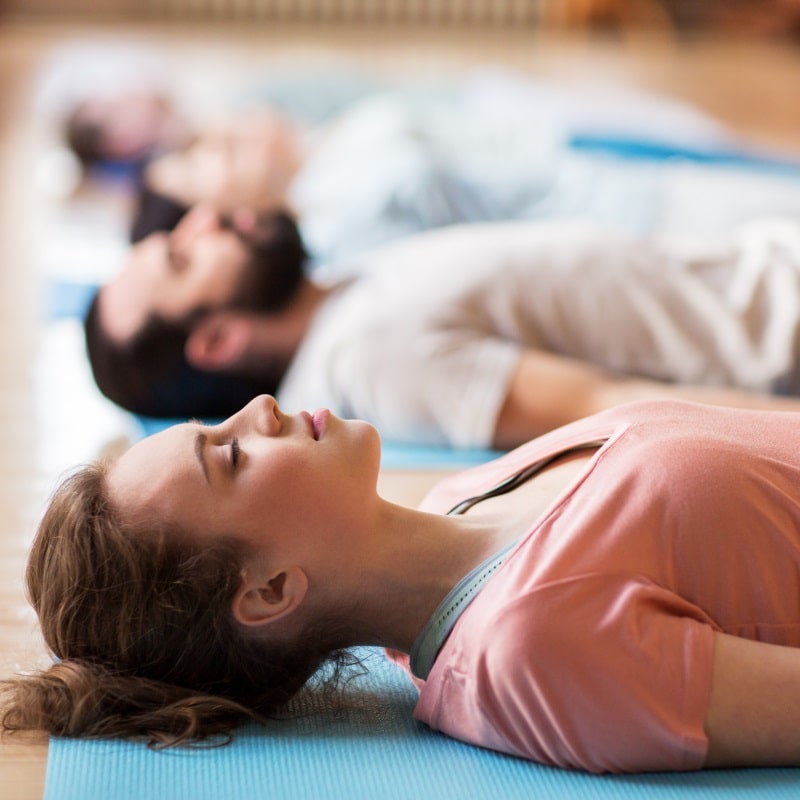
Satyananda Yoga Nidra is a profound tantric technique codified by Sri Swami Satyananda Saraswati, the founder of the Bihar School of Yoga. While the term “Yoga Nidra” appears in ancient texts, the systematic practice we use today is a modern adaptation of the ancient tantric ritual of Nyasa. It is not merely relaxation or a “nap,” but a state of dynamic sleep where the body rests while the consciousness functions at a deeper level.
The practice is rooted in the Mandukya Upanishad, which describes the four states of consciousness: waking (Jagrat), dreaming (Svapna), deep sleep (Sushupti), and the transcendental state (Turiya). Swami Satyananda observed that when people are tired, they simply fall into unconscious sleep, losing the opportunity for transformation. He developed this system to allow the practitioner to hover at the threshold between sleep and wakefulness—the hypnagogic state—where the subconscious mind is most receptive.
A session of Satyananda Yoga Nidra follows a specific, scientific sequence designed to withdraw the senses (Pratyahara) and systematically relax every layer of the being (the Koshas):
Preparation: Settling into Shavasana and resolving to stay awake.
Sankalpa (The Resolve): A short, positive statement planted in the subconscious.
Rotation of Consciousness: Moving the mind rapidly through the body parts to “reset” the motor cortex of the brain.
Breath Awareness: Focusing on the rhythm of the breath to trigger the parasympathetic nervous system.
Opposite Sensations: Experiencing heat/cold or pain/pleasure to balance the brain’s hemispheres.
Visualization: Using archetypal imagery to clear the “samskaras” (mental impressions).
Return: Re-stating the Sankalpa and gradually returning to external awareness.
Yoga Nidra is often called “the sleepless sleep.” One hour of this practice is said to be equivalent to four hours of conventional sleep in terms of nervous system recovery.
Stress Management: It significantly reduces cortisol and addresses psychosomatic disorders like hypertension and digestive issues.
Mental Clarity: By clearing mental clutter, it enhances memory, creativity, and learning capacity.
Emotional Healing: It provides a safe space to process deep-seated traumas and anxieties without the “fight or flight” response.
Spiritual Awakening: It serves as a bridge to meditation (Dhyana), leading the practitioner toward the realization of the Higher Self.
The Bihar School of Yoga emphasizes that Yoga Nidra is the path to achieving a state of “witnessing” (Sakshi). The connection between the practice and the cessation of suffering is echoed in the classical texts:
योगनिद्रा लयं न याति। (Yoganidrā layaṃ na yāti) “In Yoga Nidra, the consciousness does not vanish into unconsciousness; it remains steady.”
The Hatha Yoga Pradipika (4.110) also refers to the state of Samadhi through similar internal absorption:
न जागर्ति न च स्वपिति न जीवति न च म्रियते। (Na jāgarti na ca svapiti na jīvati na ca mriyate) “One is neither awake, nor sleeping, neither living (in the worldly sense) nor dying; they are in the state of Bliss.”
Furthermore, Swami Satyananda often quoted the essence of Yoga as defined by Sage Patanjali:
योगश्चित्तवृत्तिनिरोधः ॥ (Yogaś-citta-vṛtti-nirodhaḥ) “Yoga is the complete mastery over the modifications of the mind-stuff.”
At Yoga Habitat and Yogveda, we utilize Satyananda Yoga Nidra as the “master key” for our students. Whether you are a student looking for better focus, a parent managing a household, or a senior dealing with the challenges of aging, this practice allows you to reclaim your peace. It is the practice of “Stillness” that allows you to face a chaotic world with a calm heart and a steady mind. By integrating this into your daily life, you honor the lineage of the Himalayan masters and the Rishis who understood that the greatest power lies within the silence of the self.
© 2010 – 2026 Yoga Habitat. All Rights Reserved.